
In this guide
In short
Turn a goal into a weekly plan by defining an observable outcome, choosing a few actions you control, and giving their prerequisites time in your calendar. Review the result regularly and adjust the plan to the week you actually have.
- Write one observable outcome and a review period.
- Define what counts as completion.
- Identify the actions you control.
This tutorial follows a fictional household that wants to cook dinner at home more often. You can use the same worksheet for a personal project, a learning goal, or another practical change.
Define an outcome you can recognize
"Be more organized" is difficult to evaluate. "Cook dinner at home on three evenings each week for the next four weeks" gives you a clear starting target.
Write why it matters and what counts. In this example, the household wants fewer last-minute dinner decisions. A simple home-prepared meal counts; an elaborate recipe is not required. A meal made from suitable reserved portions also counts.
Define these terms before tracking. Otherwise, the target may become stricter whenever you make progress.
Identify actions you can control
The household cannot guarantee that work will finish on time every evening. It can choose meals, check ingredients, shop beforehand, and keep a simple fallback available.
Separate the outcome from the supporting actions:
| Part of the goal | Example |
|---|---|
| Desired outcome | Three home-prepared dinners each week |
| Planning action | Choose suitable dinners during the weekly review |
| Resource check | Look for usable ingredients before shopping |
| Preparation action | Buy missing items before the first planned dinner |
| Repeated action | Prepare dinner on the selected evenings |
| Review action | Record what happened and why the plan changed |
A calendar filled with the final activity alone misses the actions that make it possible.
Put the first week on the calendar
Start with the actual commitments for the coming week. In the example, Tuesday has a late meeting and Friday is already social. Monday, Wednesday, and Thursday are the chosen home-dinner evenings.
| When | Action | Completion condition |
|---|---|---|
| Sunday, 17:00 | Choose three dinners and check ingredients | Meals selected; missing ingredients listed |
| Monday, before dinner | Buy missing ingredients | Needed food available for the selected meals |
| Monday evening | Prepare the first dinner | Dinner prepared at home |
| Wednesday evening | Prepare the second dinner | Dinner prepared at home |
| Thursday evening | Prepare the simplest dinner | Dinner prepared at home |
| Sunday review | Check the result and next week's commitments | One useful adjustment chosen |
Choose times that fit your life. If Monday shopping cannot happen before cooking, move the shop or choose a dinner that uses existing supplies.
Make the fallback part of the plan
Write a short response to a likely disruption: "If Thursday runs late, use the simple fallback meal from ingredients already available."
The fallback should support the purpose of the goal. It should not add a second list of obligations. If the household is still learning the routine, repeating a familiar dinner may be more useful than choosing a new recipe every time.
Avoid claiming that a smaller version meets a target when it does not. If the outcome was three dinners and you prepared two, record two. You can still recognize the useful work and adjust the following week.
Review evidence without turning it into a score of your worth
Track only what helps you decide. A count and a short note may be enough.
| Week | Planned dinners | Actual dinners | What happened | Next adjustment |
|---|---|---|---|---|
| 1 | 3 | 2 | Thursday recipe required too much preparation | Choose a faster Thursday meal |
| 2 | 3 | 3 | Shopping happened before the first dinner | Keep the shopping slot |
| 3 | 3 | 2 | Unplanned evening travel | Keep an easier fallback available |
| 4 | 3 | 3 | Meals matched the calendar better | Continue with the same target |
These fictional results illustrate review decisions. They are not evidence that this method produces a particular success rate.
At the end of the four weeks, decide whether to keep the target, change it, or stop. Add complexity only when it helps the underlying purpose.
Use the action plan in Planique
Schedule the concrete actions in the relevant areas: meals in Meal planner, preparation tasks in Calendar, and relevant spending in Budget. Keep the goal statement and review notes somewhere you will revisit, such as a journal entry.
Use consistent wording so you recognize the actions that support the goal. You can use this method without assuming that the app automatically links every action to a universal goal record or calculates your progress.
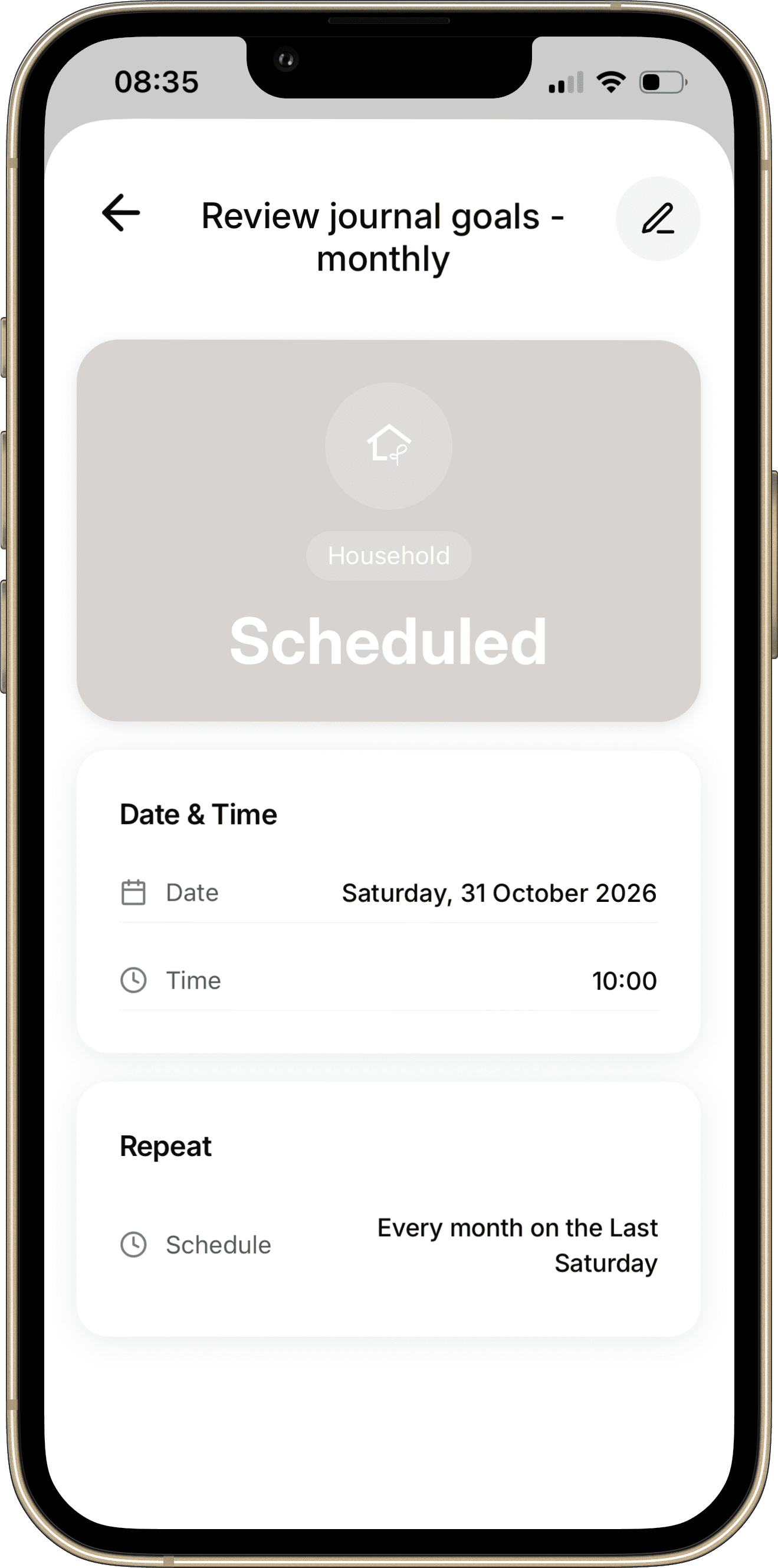
Give the review its own scheduled task. The screenshot shows a monthly reminder; for the four-week dinner example, schedule a weekly review so you can adjust the next week’s actions.
Your goal-to-week checklist
- Write one observable outcome and a review period.
- Define what counts as completion.
- Identify the actions you control.
- Schedule prerequisites before the main activity.
- Match the actions to the coming week's capacity.
- Choose a realistic fallback.
- Track the result and one reason for changes.
- Make one useful adjustment at the review.
Common questions
How many goals should I work on at once?
Start with the number whose actions fit your existing responsibilities. One well-supported change can reveal more than several targets with no time assigned.
What if I miss the target in the first week?
Record the result and identify the main obstacle. Change the action, preparation, or target when the evidence suggests it was unrealistic.
Should every goal have a daily habit?
No. Some goals need occasional project sessions or one important decision. Choose the rhythm that fits the work rather than forcing everything into a daily streak.
Continue with How to Plan Meals Around a Busy Week for a full example of the food-planning actions used here.
Make it your own
Goal-to-week plan worksheet
Use the blank worksheet to plan your own example. Print it or save it as a PDF from your browser. It is a planning document and does not import records into the app.
Open printable worksheetKeep the details with the plan.
Explore how Calendar fits into Planique Planner's connected approach to everyday planning. Planique is in early access.